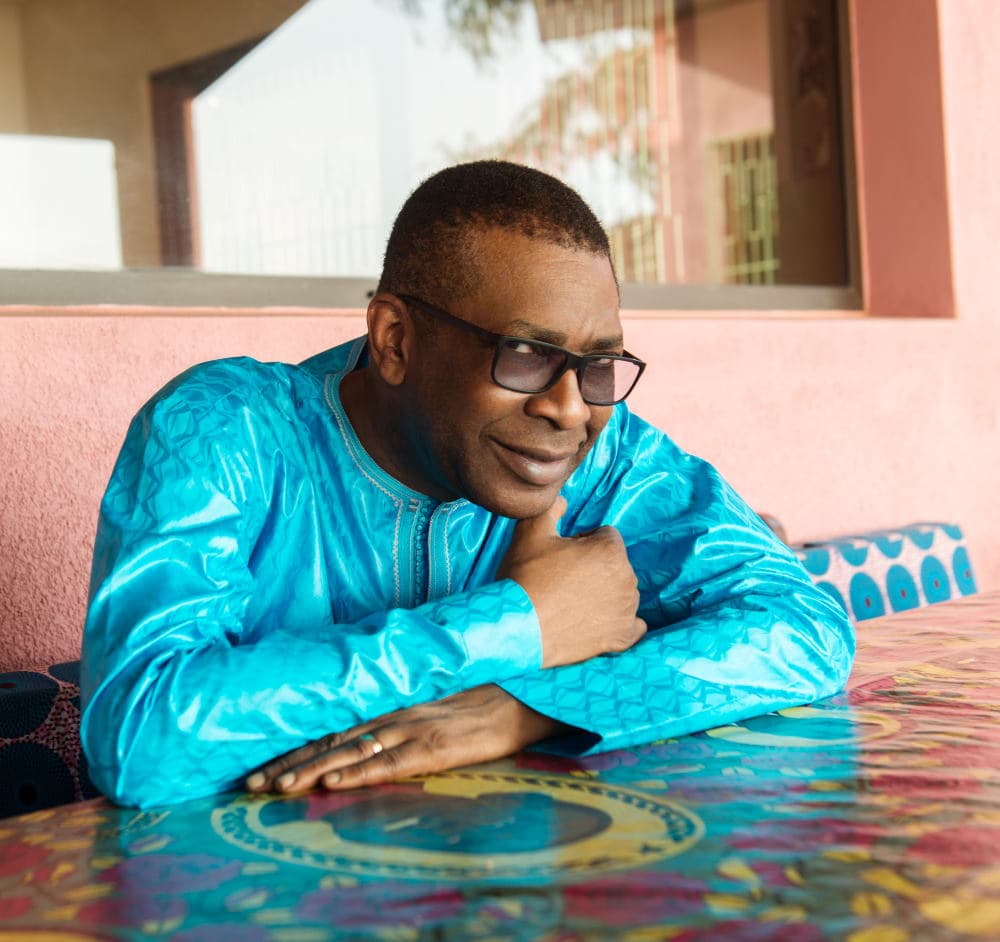
A little prince of the Dakar medina since his early youth, Youssou Ndour is now growing and evolving within the wider matrix of Africa, influenced by the entire continent’s sounds, moods, and successes. Ndour’s Africa is a continent that’s alive, always in motion. It is therefore an open and informed album that the Senegalese artist offers us. Ndour has never hidden the importance he attaches to linking the past to the future. Even though internet use in Dakar is widespread and the medina has embraced electronica, the griots, Sufi brotherhoods, and enlightened Islam still have—perhaps even more now than before—their place there.
This is what History is made of: African trees like baobabs and filao, but also optical fibers. In Ndour’s Africa, modernity is a question of lineage, the chain that gives birth and death, nourishes and recreates. In the big golden trunk of African music, History unearthed a precious nugget: Babatunde Olatunji. He was born in Nigeria in 1927 and died in 2003 in the United States, where he had settled. A composer and percussionist adored by the 1950s jazz avant-garde, Olatunji was copied by another brilliant musician, Serge Gainsbourg, who heard his 1959 album Drums of Passion, produced by John Hammond. Gainsbourg later gave credit where it was due by attributing three songs on Gainsbourg Percussions (1964) to “Baba.”
Babatunde Olatunji was fully Yoruba, just as Youssou Ndour is at once Serere, Toucoleur, and Wolof. The Nigerian drummer, who was an activist for equal rights in the United States, also sang with remarkable incantational freedom. Ndour chose to compliment Olatunji’s creations by covering two of his songs, “My Child” and “Dakuta,” “by respecting his vocal tracks but modifying the musical production.” The young Nigerian Spotless (Augustine Huche Ezra), who collaborated with Ndour on his previous album, Africa Rekk (2016), is in the control room again, and is very present on History. Fresh, balanced, guitar-laced, rhythmic, the two albums of this trailblazing Nigerian have stood the test of time.
Ndour had a remarkable early career. He began singing at the age of 13, in the early 1970s, and founded his orchestra, the Super Etoile of Dakar, in 1979. He applied his desire to explore the past to his own songs. In 1989 he completed “Salimata,” which came out on the special album Set Jamm, released while Ndour, who had been discovered in Senegal by Peter Gabriel, was preparing to enter the world music scene with the album The Lion. «It’s a love song,» explains Ndour.»I got up one morning, went outside, and met a beautiful young woman, and it was love at first sight! Her name is Salimata. That very evening, I told my mother that I was in love.” Voice unchanged, accompanied by romantic saxophone, the Babatunde Olatunji (April, 7th 1927 - April, 6th 2003) 2019 rerelease of “Salimata,” is clean, a tad retro, and charming.
Another love song, “Ay Coono La,” closed the album Set (1990). For History, it has been reshaped into satin loops by Spotless, evoking love-induced mistakes, composed by Ndour and his bassist Habib Faye. History actually opens with a tribute to Faye, who died in April 2018: «Habib Faye has been my friend, bassist, and music director for almost twenty years. Together we created many songs and played many shows around the world. Naturally, this is the first song I wrote for this album.» With intersecting, pan-African rhythms, Ndour softens his mbalax.
With Habib at his side, he sang “Birima,” one of his undisputed successes, written in 2000 for the album I Bring What I Love, countless times. Ndour has recreated it for History with an exceptional young woman, Seinabo Sey, a Swede of Senegalese origin born 28 years ago in Stockholm. A star of the new Scandi-navian electro soul scene, Sei sings in English in a warm voice, on the edge of androgyny, on this ballad composed as a tribute to African values and ancestors. Also from Sweden, Mohombi Moupondo— born to a Congolese father and a Swedish mother—who founded the band Avalon in the 2000s, shares with Ndour the English-language hit “Hello.”
The album also features new songs, like “Confession,” «The story of an immigrant working in Europe to support his family in Senegal. Back home for the holidays, he falls in love with a woman who does not share his feelings, and does not want to return to Europe.» This difficult situation is supported by an elegant piano loop and of course by Ndour’s voice. Composer Mike Bangerz (BRGZ), a French beatmaker of Beninese origin, programmed the song.
On “Macoumba,” BGRZ, Ndour, and the Cameroonian saxophonist Alain Rodrigue Oyono enthusiastically play with the codes that rule Dakar’s streets, where a macumba is a dull gambler. Brought back down to earth with humor, ridiculed for his expensive ego-trip, the song’s careless young protagonist is called to get back to work.
History was recorded in Dakar and mixed in Doha, Qatar, by the American Matt Howe, who has collaborated with some of the world’s best artists and won a Grammy in 1998 for his production work on the album The Miseducation of Lauryn Hill.
History would be a tower of Babel, just like “Tell Me” (in English, French, and Wolof) which concludes the album, if the musical science of Youssou Ndour was not anchored in the musical traditions of his mother, Ndèye Sokhna Mboup, a griot in Nelson Mandela’s fighting Africa; and in the values taught by the Mouride brotherhood, founded by Sheikh Ahmadou Bamba. Ndour honored the brotherhood’s values with his golden voice on the album Egypt, which earned him a Grammy in 2005, a decade after the ever-fascinating “7 Seconds,” an absolute hit recorded with Neneh Cherry.
Youssou N'Dour gracing us with musical performances and interviews.